Plastics Industry: a viable path for small businesses
Staff writer, 21 April 2026.
The South African plastics industry is broad and presents a considerable number of new markets for the manufacturing sectors. Plastics touch almost every part of the economy, and this sector provides numerous entry points for small businesses and many of these entry points are accessible, scalable, and aligned with national priorities such as localisation, circular economy development, and job creation.
However, the industry also comes with tough challenges that Small and Medium Enterprises (SMEs) must work around with strategy, commitment, and support.
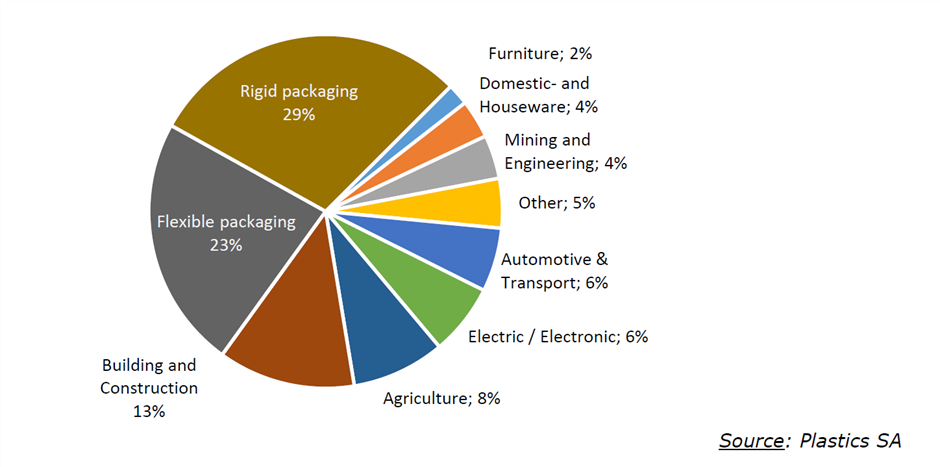
According to Plastics SA, South Africa’s plastics industry is largely led by the packaging segment, which makes up 52 % of the domestic market, followed by building and construction at 13 % and agriculture at 8 %.
Small business opportunities in the plastics industry
1. Demand for plastic products
Demand for plastic products remains high across sectors. In fact, plastics are essential in packaging, agriculture, construction, automotive, retail, medical supplies, and household goods. This creates a diverse and stable market for small businesses that produce items such as buckets, basins, and household containers; PVC pipes and fittings; plastic bags and packaging; seedling trays and agricultural products; plastic furniture; and automotive clips and components. It is worthy to note that demand for everyday plastic goods remains strong even in tough economic times.
2. Recycling and Circular Economy
South Africa’s recycling sector is one of the most active in Africa. SMEs can enter through collection and sorting, washing and pelletising, manufacturing products from recycled plastic, as well as supplying recycled pellets to larger manufacturers.
Products made from recycled plastic include, among others, eco‑bricks, outdoor furniture, pallets, construction boards, school desks, and packaging materials. Opportunities in this area of the industry are growing and aligned with government priorities.
3. Technology entry points
The plastics industry accommodates low‑tech SMEs that focus on bag‑making, simple moulding, household goods, recycling collection, and small‑scale extrusion. The industry also caters for high‑tech SMEs whose business is injection moulding, blow moulding, 3D printing, automotive components, and industrial packaging. This flexibility allows SMEs to start small and scale gradually.
4. Localisation and import replacement
We have come to know that South Africa imports a good number of plastic products. The localisation drives by government and private sector are creating new markets for SMEs to manufacture packaging, containers, construction materials, automotive parts, and industrial components. Local suppliers that can deliver faster and customise products are fast getting preference from local buyers.
Challenges faced by small businesses
Despite all the good opportunities that the sector has for small businesses, there are also significant challenges that small businesses must navigate to operate successful ventures in the industry. Below is a list of major barriers for new entrants that do have funding support. The list is not exhaustive.
- Expensive machinery and tooling
- Strong competition from imports
- Complex compliance and standards
- Energy costs negatively affects production
To run profitable enterprises in the industry, it is key that SMEs must differentiate themselves, not imitate. It is concerning that many SMEs underestimate industry requirements, and as a result, struggle to gain access.
Perhaps one of the most pressing issues facing SMEs is that they struggle to maintain consistent output. This obviously has an adverse effect on their business prospects.
Government funding
The good news is that several government entities support manufacturing, recycling, and technology adoption through various programmes and incentives. Among these entities we count the Department of Trade, Industry and Competition (the dtic), Small Enterprise Development and Finance Agency (SEDFA), and Industrial Development Corporation (IDC).
Wrap up
Without any measure of doubt, the plastics industry has real, scalable opportunities for South African SMEs ranging from manufacturing and recycling to packaging and industrial components. To be a meaningful player in the industry, readiness, investment, and strategic support are essential.
Government funding is available, but small businesses must ensure that they are structured, compliant, and well‑prepared to access it.
Ground for growth.
